
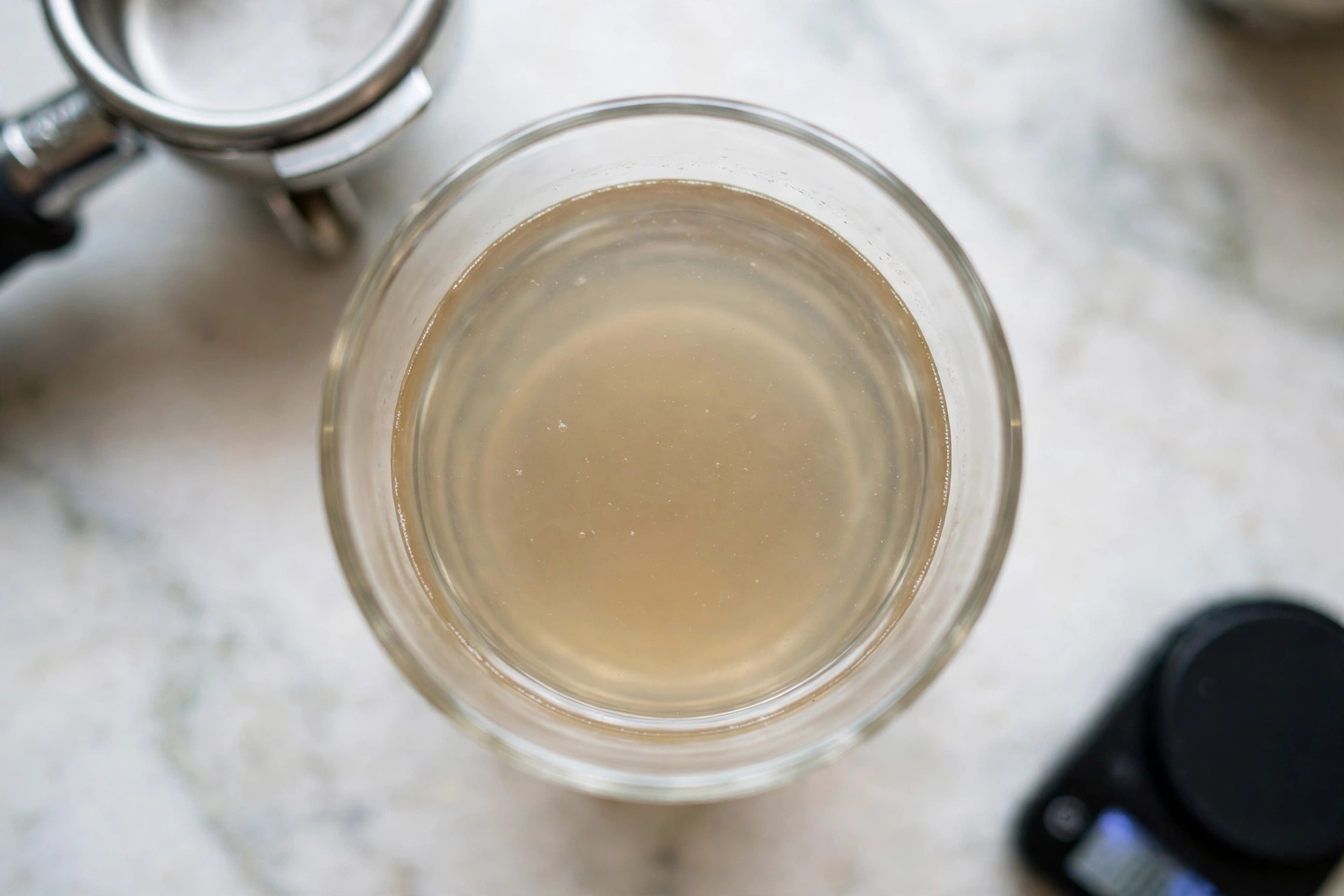
The short answer: watery espresso is a strength problem — too little dissolved coffee for the water in the cup — and the first thing to check is the weight of the shot, not the grinder. A shot run past about 1:2.5 dilutes itself no matter how good the grind was; a shot that ran in under 20 seconds never dissolved enough coffee in the first place. Weigh the yield first, then the time.
Disclosure: we are an independent research desk and earn no commission on anything here. This page contains no affiliate links. See our disclosure policy for how we stay independent.
We are a research desk, not a test lab: we synthesize manufacturer specifications, owner reports, forum threads, and published guides rather than claiming hands-on testing we have not done.
What “watery” actually is
Every espresso is described by two different numbers, and confusing them is why “grind finer” sometimes fixes a watery shot and sometimes does nothing:
- Strength is how much dissolved coffee is in the liquid in the cup — roughly 8 to 12 percent dissolved solids in a balanced shot. Watery means this number is low: the cup is mostly water.
- Extraction yield is how much of the dry dose actually dissolved — the Specialty Coffee Association puts the sweet spot at roughly 18 to 22 percent of the coffee’s mass. Low yield means the water left flavour behind in the puck.
Watery lives in the relationship between them, and it arrives by two opposite roads. Dilution: the extraction was fine, but too much water passed through — the yield kept growing while the strength fell, the way adding water to a finished cup thins it. Under-extraction: the water rushed through too fast to dissolve much at all, so both numbers are low and the cup is thin and sharp. That is why the first diagnostic is not the grinder but the scale: a heavy cup points to dilution, a fast cup points to under-extraction, and the fixes are different.
One distinction before the causes: watery is not the same as sour. Sour is a flavour — sharp, puckering, acids with no sweetness behind them — and we cover it in why is my espresso sour. Watery is a texture and strength problem: the cup tastes thin and diluted, like weak coffee, whatever its flavour. A shot can be sour without being watery, and a shot pulled to a very long ratio can taste watery without being sour, because the extra water diluted an otherwise balanced extraction. They share causes — grind and ratio — but in opposite directions.
The causes, in the order to check them
1. Ratio ran too long — the dilution trap
This is the most overlooked cause, because it looks like good technique: the shot ran to time, the stream looked right, and the cup still tastes thin. Ratio is the relationship between your dose of dry coffee and the weight of liquid espresso in the cup, and a standard starting point is 1:2 — an 18g dose yielding about 36g of liquid. Let the shot run to 45, 50, or 60g from that same 18g and you have diluted your own shot: past about 1:2.5 it starts tasting thin and washed out no matter how good the grind was, because each extra gram of water carries almost no new dissolved coffee with it.
Stop the shot by weight, not by the timer and not by the colour of the stream. Put a scale under the cup, pull to about 36g from 18g in, and taste from there. This is the cheapest fix on the list — it costs no beans and no adjustments — and it is the diagnostic that separates the two roads: if stopping at 36g fixes the cup, the problem was never the grind. See espresso vs lungo vs ristretto for where a long shot stops being espresso at all.
2. Grind too coarse — the fast shot
Grind size controls how much resistance the puck gives the pump. Coarser grounds mean larger gaps between particles, so water finds its way through quickly and contacts less coffee surface. The shot runs fast — under 20 seconds for a standard double instead of 25 to 30 — the stream comes out pale and thin, the crema is light and dissipates fast, and the cup is thin and sharp at once: under-extracted and weak.
The fix is one or two steps finer on the grinder, then a fresh test shot, stopping at about 36g. If an 18g dose was reaching 36g in 15 seconds, a finer grind should push that toward the 25 to 30 second region, and the body should return as it does. Grinders respond nonlinearly near the espresso range, so a tiny adjustment can shift timing by several seconds; move in small increments and taste each shot. If several steps finer barely changes the time, the cause is further down this list, not the grind. Our guide to espresso extraction too fast covers the fast-shot side of the picture in full.
3. Dose too low for the basket
Too little coffee leaves a thin puck with too little resistance, and water rushes through it — under-extraction by another name. This one is easy to miss because the grinder gets blamed first: a shot can run fast and watery at any grind setting if the basket is underfilled, and adding water to the cup only makes it worse.
Weigh the dose against the basket’s rated capacity rather than eyeballing it. Most double baskets are designed for about 18 to 20g — check your specific basket, since this varies by manufacturer — and stay within a gram or two of that number. If the puck looks thin or the shot runs fast no matter how fine you grind, add coffee before touching the grinder again. See espresso grind size guide for how dose and grind work together.
4. Channeling — thin and bitter together
If the shot tastes watery and bitter in the same sip, that is usually channeling, not a wrong extraction level. Water finds a crack through the puck and rushes through it, so most of the coffee is under-extracted and thin while the coffee along the channel is over-extracted and harsh. The shot often sprays, spurts, or runs blonde-then-dark, and the puck shows a visible hole or crack after the shot.
Fix distribution before changing anything else: break clumps with a WDT tool, level the surface, then tamp straight and square. Our channeling guide walks through the full routine in order. Note the diagnostic value here: a shot that is watery alone points to ratio, grind, or dose; a shot that is watery and bitter together points to the puck.
Tamp force, for completeness, is almost never the cause. Once the puck is fully compressed, pressing harder adds almost nothing to resistance — the bed cannot get denser. What matters is squareness: a tilted tamp builds a density gradient, and water stalls in the dense side while rushing through the loose one. Press straight down with consistent, moderate force and move on.
5. Water too cool
Cooler water extracts less, and it favours the sharp, acidic compounds over the sugars and body that make a shot feel full. The usual target band is 93 to 96°C (195 to 205°F); water below that pulls out too little of everything, and the cup tastes thin as well as sharp. The classic tell is the first shot of the day: the machine looks ready, but the group head and portafilter are still cold metal, acting as heat sinks that can drop the water temperature by several degrees before it reaches the coffee.
Let the machine warm up for at least 15 to 20 minutes before the first shot, run a blank flush through the group to heat it, and lock in a warm portafilter. If your machine lets you adjust temperature — a PID controller, or a temperature setting on a prosumer machine — raise it by one or two degrees and taste. If your machine has no temperature control, a finer grind and a shorter ratio are the levers you have instead. See is a PID worth it on an espresso machine for why temperature stability matters so much on this fault.
6. The beans — stale, or too fresh
Crema is mostly carbon dioxide that fresh-roasted coffee releases under brewing pressure, and it is also a rough signal of body: beans more than about four weeks past their roast date have released most of their CO2, so the shot looks thin and flat, and they have lost the soluble compounds that give the cup its weight. No grind adjustment restores what the beans no longer contain.
Freshness cuts both ways. Beans roasted within the last two or three days are still releasing carbon dioxide, which can make shots run fast and taste sharp; give them a few days to degas. At the other end, beans past three or four weeks off the roast date lose their sweetness and body first, so the cup tastes hollow — and whole bean vs pre-ground matters here too, since pre-ground coffee stales faster once the bag is open. The fix is a test, not a purchase: before blaming your hands, pull a shot with a fresh medium roast you trust. If the body returns, it was never your grind — it was the bag. See light vs dark roast for espresso for how roast level changes what a shot can deliver.
7. Machine pressure and scale
Espresso needs about 9 bars of pressure to force water evenly through a fine puck. A machine that cannot reach it — a tired pump, a scaled boiler, a worn group gasket leaking pressure around the portafilter — produces a shot that runs fast and thin whatever the grind, because the water was never pushed through the coffee with enough force to extract it properly.
Rule this out after the recipe checks, not before: if the shot is watery at every grind setting and the machine is old, overdue a descale, or hisses and drips around the group head, the machine is the suspect. Descale on schedule, replace a hardened or cracked group gasket, and check the pump against the manufacturer’s specification. See how often to clean and descale your espresso machine and how to backflush for the maintenance routine that keeps pressure where it belongs.
8. A pressurized basket
A dual-wall (pressurized) basket forces coffee through a small exit valve, which controls flow regardless of the puck — see pressurized vs non-pressurized baskets. It can fake the look of a proper shot, including crema, while the coffee underneath is thin and under-extracted, because the valve, not the puck, is doing the work. Timing and grind rules still apply, but the basket masks puck errors, so a watery shot there points to the coffee, the grind, or the temperature rather than distribution. If your shots are consistently thin and you are using the basket that came in the box, check whether it is pressurized before troubleshooting anything else.
Diagnose it in one shot
Pull a shot the way you normally would, weigh the yield, watch the time, and match what you see and taste:
| What you see and taste | Most likely cause | First move |
|---|---|---|
| Thin, shot ran to time but yielded 50g or more from 18g | Ratio too long — dilution | Stop by weight at about 36g |
| Thin and sharp, shot ran in under 20 seconds | Under-extraction, grind too coarse | One or two steps finer, retest |
| Thin at every grind setting, puck looks thin | Dose too low | Weigh dose to basket capacity |
| Thin and bitter together, flow uneven or spurting | Channeling | WDT, level, tamp square |
| Thin only on the first shot of the day | Machine not up to temperature | Warm up 15–20 min, flush the group |
| Thin however you pull it, beans past 4 weeks off roast | Stale beans | Change beans, retest |
| Thin at every setting, machine old or overdue a descale | Low pressure / scale / worn gasket | Descale, check gasket and pump |
The fix routine
Work through the causes in order, changing one thing per shot:
- Weigh the yield. Put a scale under the cup and stop the shot at about 36g from an 18g dose. If the cup was running to 50g or more, this alone may fix it.
- Lock the dose. Weigh about 18g into the basket and keep it fixed for the whole session. Dose is the constant; grind is the variable.
- Grind one or two steps finer. Pull a fresh shot, stop at about 36g, and time it. Repeat in small steps until the shot lands in 25 to 30 seconds and tastes full.
- If the shot is still thin at the right time and ratio, fix distribution. WDT, level, tamp square — then retest before touching the grind again.
- If the shot is still thin, raise the temperature by one or two degrees if your machine allows it, and flush the group before the shot.
- If the shot is thin however you pull it, test the beans. Pull a shot with a fresh medium roast you trust; if the body returns, the bag was the problem.
- If nothing above changes it, check the machine. Descale, inspect the group gasket, and confirm the pump still reaches pressure.
Do not change grind, dose, and temperature in the same session. Each change teaches you something only if the other variables stay put — and the problem returns the moment one of them slips back.
When it is not a watery-shot problem
A few things look like watery espresso but are not:
- A lungo, pulled on purpose. A long shot is a different drink by design — more water through the same dose, thinner by definition. If you wanted a lungo, the thinness is the recipe working, not a fault.
- A milk drink. Milk dilutes espresso by design; a latte made from a good shot still tastes mild next to a straight double. Judge the shot before the milk goes in, not after.
- A shot that is sour, not watery. A sour shot tastes sharp and puckering; a watery shot tastes thin and diluted. They share causes — grind and ratio — but in opposite directions, and our guide to why is my espresso sour covers the sharp side of the picture.
- The mirror problem. If your shots taste bitter and harsh instead of thin, the causes are the same variables in reverse — too fine a grind, too long a ratio, water too hot. Our guide to why is my espresso bitter covers the other half of the spectrum, and how to dial in espresso ties the whole routine together.
- A light roast’s natural brightness. Light roasts are denser and less soluble, so at the same grind and ratio they under-extract more easily — and they carry more natural acidity on top. If a light roast tastes bright and thin at every setting and a medium roast does not, the roast is the answer, not the recipe — extract harder, with a finer grind and a slightly longer ratio, rather than chasing a darker-tasting cup.
The bottom line
Watery espresso is a strength problem, and strength is set by two numbers: how much water you let through, and how much coffee dissolved into it. A shot run past about 1:2.5 dilutes itself no matter how good the grind was; a shot that ran in under 20 seconds never dissolved enough coffee in the first place. Weigh the yield, stop the shot at about 36g from 18g in, in 25 to 30 seconds, with the machine properly warmed up and beans inside their fresh window. When the shot lands there and tastes full with a clean finish, the extraction is doing its job.