
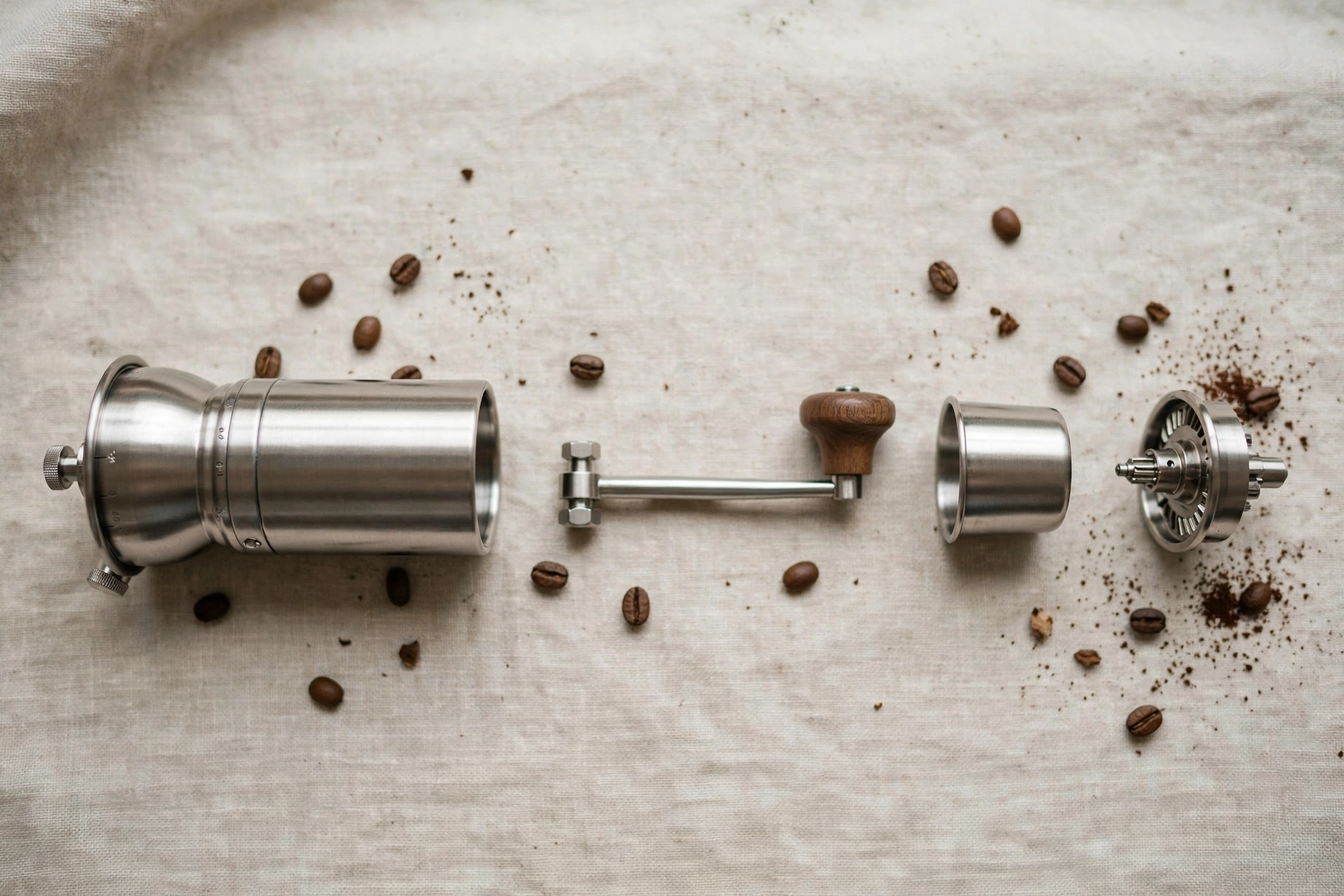
The short answer: the 1Zpresso J-Ultra is the best hand grinder under $200, the 1Zpresso JX-Pro is the best all-rounder at about $159–189, the KINGrinder K6 is the best value at about $93–109, and the Timemore Chestnut C3 ESP Pro is the cheapest hand grinder we would trust with a non-pressurised basket at about $80–99. Every pick below is a specific, current product with a checked price, and every one of them grinds fine enough for real espresso — the differences are adjustment resolution, burr size, and how much cranking your mornings can absorb. Prices and specs checked 2026-11-23. Prices vary by retailer; where sources disagreed we used the manufacturer’s current price.
Disclosure: we are an independent research desk and earn no commission on anything here. Vendor links on this page are plain links to manufacturer pages — no affiliate tracking. See our disclosure policy for how we stay independent.
We are a research desk, not a test lab: we synthesize owner reports, forum threads, published measurements, reviews, and teardowns rather than claiming hands-on testing we have not done.
First principles: what the $200 ceiling means for a hand grinder
Espresso is a flow-control problem. You push water at about 9 bars through a compacted puck and want about twice the dose’s weight in the cup in about 25 to 35 seconds. The puck’s resistance — and therefore the shot time — is set almost entirely by grind size. A few tens of microns finer and the shot chokes; a few tens coarser and it gushes sour. That sensitivity dictates the three properties that separate an espresso hand grinder from a travel filter grinder:
- Adjustment resolution at the fine end. The burr gap must change in small, repeatable increments where espresso lives. Manufacturers quote this as microns per click. About 16 microns per click or finer gives you landing room; 25 to 30 microns per click means the ideal setting regularly falls between clicks, and you fudge it with dose changes that alter flavour as well as flow. The grinders below span 8 to 23 microns per click, and that spread is the whole price ladder in miniature.
- Burr size, geometry, and alignment. The burrs produce a distribution of particle sizes, not one size. A tighter distribution extracts evenly; a wide one gives bitter fines and sour boulders in the same cup. In hand grinders this is mostly about burr diameter (38mm to 48mm in this class), burr geometry, and shaft stability. Dual bearings and rigid, all-metal frames keep the burr from wobbling under load, and wobble is what smears the distribution at fine settings.
- Retention and dosing honesty. Hand grinders are naturally single-dose machines with short grind paths, so retention is low — typically well under half a gram. What you weigh in is essentially what lands in the basket. That is a genuine advantage over hopper-fed electrics at this price, and it is why a hand grinder plus a scale is the cheapest accurate dosing system in espresso.
The $200 ceiling matters because it is where a hand grinder stops being a compromise and starts beating electrics outright. Below it, every dollar goes into burrs and adjustment instead of a motor, a case, and electronics — which is why the best grinder under $200 for pure shot quality has no motor at all. Above it, in our best grinders under $400 roundup, electrics take over on workflow while the J-Ultra still holds its own on grind quality per dollar. This page is the hand-grinder half of that story, cut at the price where the trade is at its most favourable: the same four grinders also appear in our best hand grinders roundup, which covers the full range up to $299 — this page answers the narrower question of what to buy when $200 is a hard limit.
Comparison table
Prices and specs checked 2026-11-23. Prices vary by retailer; where sources disagreed we used the manufacturer’s current price.
| Grinder | Typical price | Burrs | Adjustment | Capacity | Weight | Best for |
|---|---|---|---|---|---|---|
| 1Zpresso J-Ultra | $199 | 48mm titanium-coated conical | External dial, 8 microns per click | 35–40g | About 700g | Best overall; finest dial-in control |
| 1Zpresso JX-Pro | ≈$159–189 | 48mm heptagonal stainless conical | Top dial, 12.5 microns per click | 25–30g | About 780g | Best all-rounder; espresso plus filter |
| KINGrinder K6 | ≈$93–109 (list $129) | 48mm heptagonal stainless conical | External dial, 16 microns per click | 25–35g | 630g | Best value; espresso plus filter range |
| Timemore Chestnut C3 ESP Pro | ≈$80–99 | 38mm S2C660 stainless conical | Internal dial, 23 microns per click | 20–25g | About 510g | Cheapest credible espresso pick |
The four grinders, in depth
1. 1Zpresso J-Ultra — best hand grinder under $200
The J-Ultra is built around one decision: put the finest adjustment in the class on the outside of the grinder. Its external ring moves the 48mm titanium-coated conical burr in 8-micron steps, 100 clicks per full rotation, with a numbered dial you can read and return to. In practice that means a shot running 22 seconds can be nudged to 26, then 29, in successive mornings — the exact behaviour espresso dialling-in requires, and the behaviour cheaper hand grinders cannot offer.
The rest of the design supports that brief. The magnetic catch cup holds 35 to 40g, the body is aluminium alloy at about 700g, the handle folds for storage, and the burr set removes without tools for cleaning without losing calibration. Owner reports consistently praise shot quality and consistently note the same two gripes: the magnetic cup can shift if you brace the grinder hard against your body mid-grind, and gripping too high on the body can nudge the dial. Both are technique problems, learnable in a week.
One honest warning about the price: $199 is the maker’s price as of 31 October 2026, and Amazon US listed $199 when we checked. That sits exactly on this roundup’s ceiling. If 1Zpresso raises the price by even a dollar, the J-Ultra leaves this band — and at that point the JX-Pro below becomes the pick, not a reason to stretch the budget. 1Zpresso backs the grinder with a one-year limited warranty. If espresso is the main event and the budget reaches $200, this is the hand grinder to buy — the adjustment resolution alone justifies it over everything below.
2. 1Zpresso JX-Pro — best all-rounder
The JX-Pro is the grinder that made manual grinding respectable, and it is still in 1Zpresso’s lineup for a reason: it is the only pick here that is genuinely as good at filter as it is at espresso. Its 48mm heptagonal stainless conical burrs are driven by a top-mounted dial with 40 clicks per rotation at 12.5 microns per click — over 200 clicks of total range — on a dual-bearing shaft. That range is the point: the J-Ultra’s dial is finer at the espresso end, but the JX-Pro covers Turkish to French press without running out of clicks, which makes it the better single grinder for a household that brews more than one way.
The trade against the J-Ultra is precision and weight. Twelve-and-a-half-micron steps are still comfortably inside the workable range for espresso — one JX-Pro click moves the shot about half again as much as one J-Ultra click — but you will occasionally land between clicks and trim dose to compensate. At about 780g it is also the heaviest grinder here, and the 25–30g catch cup is the smallest. 1Zpresso backs it with a one-year warranty and a 300kg burr-life guarantee.
Pricing is the one thing to watch: the JX-Pro sells through 1Zpresso direct and Amazon at about $159–189 depending on the seller, and stock comes and goes. At $159 it is a clear buy over the K6 if you want the finer dial and the longer track record; at $189 it is $10 from the J-Ultra, and the J-Ultra is the better grinder. Check the current price before you commit, and buy the J-Ultra if the gap has closed to single digits.
3. KINGrinder K6 — best value
The K6 undercuts the 1Zpresso grinders by doing almost everything slightly less finely. You still get 48mm heptagonal stainless conical burrs and an external adjustment dial, but each click moves 16 microns rather than 8 or 12.5. That is still comfortably inside the workable range for espresso — two K6 clicks roughly equal the shot-time change you would split into four on the J-Ultra — and the same mechanism covers filter brewing well, which makes the K6 the better hybrid if pour-over shares equal billing with espresso.
The aluminium body weighs 630g, capacity is 25 to 35g, and the drive shaft accepts a standard hex bit, so a cordless drill can substitute for your arm on high-volume mornings. Owners rate grind quality well above the price and note a less premium finish and an uncalibrated zero point: your click count starts wherever assembly left it, so write settings down relative to your own zero.
KINGrinder’s list price is $129, and Amazon US listed about $93 in November 2026, with a 90-day average of about $107 — the street price moves with sales, so treat $93–109 as the range to expect rather than a fixed number. At that money, nothing else new grinds espresso this well for less. Choose it over the J-Ultra if you brew filter as often as espresso or the budget stops at about $110, and over the JX-Pro if the $60-plus saving matters more than the finer dial.
4. Timemore Chestnut C3 ESP Pro — the sub-$100 floor
The C3 ESP Pro is the entry point, and its spec sheet is honest about what about $80–99 buys. The S2C660 stainless conical burrs are 38mm rather than 48mm, so grinding is slower and takes more turns; the adjustment is an internal dial with 30 clicks per rotation at 0.0233mm per click — about 23 microns, coarse enough that you will sometimes split the difference with dose. Against that, the all-metal body has no plastic internals, dual bearings keep the shaft stable, and the whole grinder weighs about 510g: a true travel format, and the folding crank handle — the Pro’s defining feature — packs flat.
The ESP variant is the one to buy — the standard C3’s coarser dial is not espresso equipment. Within the ESP version, owner reports are consistent: real espresso is achievable and repeatable once you accept longer grinding and the occasional between-clicks compromise. This is the grinder for a first non-pressurised setup, a travel kit, or a deliberate test of whether the hand-grinding ritual suits you before spending J-Ultra money.
Two buying notes. First, the plain C3 ESP is the same grinder with a fixed handle instead of a folding one — same burrs, same dial, same grind — and it was listed at $68 on Amazon in November 2026, cheaper than the Pro. Buy whichever is cheaper the week you shop; the grinding is identical, and a lot of writing online wrongly credits the plain ESP with a folding handle. Second, Timemore publishes the capacity inconsistently — its series table says 20g while its product page and retailers say 25g — so treat 20–25g as the honest range and single-dose accordingly. If you find yourself grinding two light-roast doubles daily, you will outgrow it on effort rather than quality — plan the upgrade path rather than resenting the tool.
Over the cap, and the superseded model
Three good hand grinders sit just above $200, and the line is worth drawing honestly rather than stretching the band to include them:
- Kinu M47 Phoenix, $219. Stepless micrometric adjustment with divisions of about 5 microns and a 47mm Black-Fusion burr set in a premium build, with a 5-year warranty. It is $19 over the cap and the best-built hand grinder in this whole conversation — if your budget flexes, it is the first place to spend the extra money. It appears in our best hand grinders roundup.
- 1Zpresso K-Ultra, $259. The all-rounder above the J-Ultra: 48mm burrs and a 20-micron external dial built for every brew method rather than espresso specifically. At $60 more than the J-Ultra it buys versatility, not better espresso — espresso-first buyers should not stretch for it.
- Comandante C40 MK4, $299. The famous name, with an espresso caveat: its standard stepped adjustment moves about 25 to 30 microns per click, which is coarse at espresso settings, and the Red Clix accessory that halves the step is effectively a required add-on. As a filter-leaning all-rounder little matches it; as a dedicated espresso grinder the J-Ultra out-specs it for $100 less.
One model that looks like it belongs here but does not: the 1Zpresso J-Max, at about $179–209, has the same 48mm burrs and an 8.8-micron external dial as the J-Ultra’s family — but 1Zpresso has largely replaced it with the J-Max S (same grinder, foldable handle) and then the J-Ultra, which costs about the same while being roughly 100g lighter with a refined burr design. Unless you find a J-Max at a genuine clearance price, buy the J-Ultra instead; paying full price for an outgoing model buys you nothing.
How to choose
- You want the best espresso results from a hand grinder under $200: 1Zpresso J-Ultra, $199. The 8-micron external dial is the finest stepped control in the class — but watch the price, because it sits exactly on the ceiling.
- You brew filter as often as espresso and want one grinder for both: 1Zpresso JX-Pro at about $159–189. The widest usable range here, with a dial fine enough for real espresso. Buy the J-Ultra instead if the price gap closes to single digits.
- You want the best value across espresso and filter: KINGrinder K6 at about $93–109. Sixteen-micron clicks, 48mm burrs, and a hybrid grind range nothing else matches at the price.
- Your budget stops at about $100: Timemore Chestnut C3 ESP Pro — and only the ESP version. Accept slower grinding and some dose-trimming between clicks, and check the plain C3 ESP first: it is the same grinder with a fixed handle and was cheaper in November 2026.
Living with a hand grinder
Budget for a 0.1g scale (about $15 to $25) alongside any pick here: single-dose grinding removes retention error, but dose error still masquerades as grind error, and only a scale separates them. Add a small brush for weekly cleaning and expect the first bag of coffee to be tuition — change one variable at a time, note dose, setting, and shot time, and taste the failures as well as the successes.
Match roast to reality. Dark and medium roasts grind markedly easier than dense light roasts; if your taste runs light and your mornings run to multiple drinks, either the drill-friendly K6 or an eventual move to electric will protect the habit. Keep the grinder dry (brush, never rinse, unless the manual allows it), store it out of steam’s path, and the burrs will outlast several espresso machines.
Meet the three mechanical conditions — fine enough resolution, a tight particle spread, and honest dosing — and a hand grinder stops being the budget option and becomes simply a different one: quieter, smaller, and cheaper per unit of grind quality than any motor. The question this list cannot answer for you is whether your arm agrees. One or two shots a day, and it almost certainly will. If you are still deciding how much a grinder should cost relative to the machine, how much to spend on a grinder explains the split — and if the budget stretches past this ceiling, our best grinders under $400 roundup shows what the extra money actually buys.