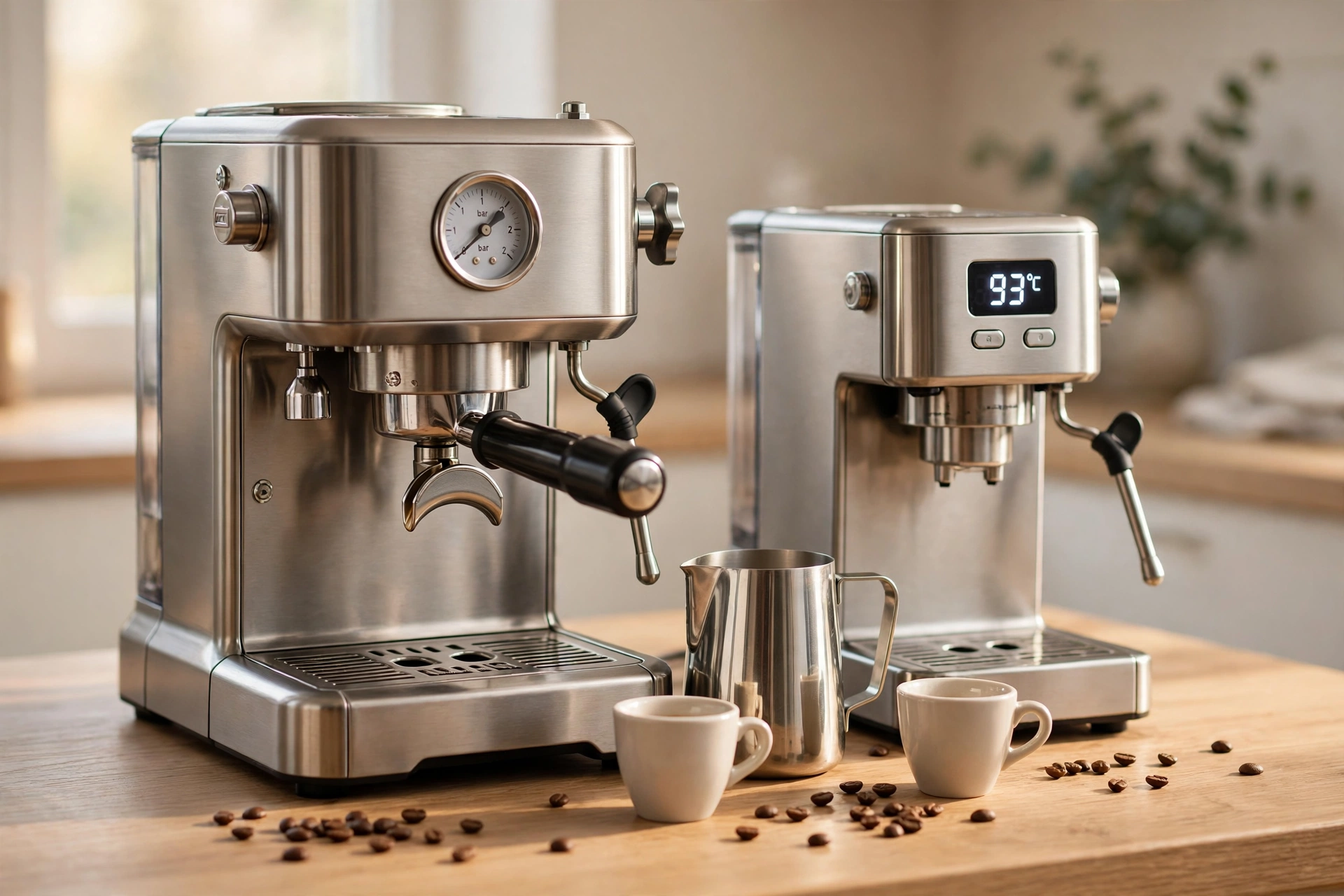
The short answer: buy the Lelit Anna PL41TEM if you want PID-controlled espresso for the least money; buy the Profitec GO if you want the 58mm standard, heavier build, and a 3-year warranty — and are willing to pay ≈$500 for them. The GO ($1,199 at Whole Latte Love and Clive Coffee) is the better machine. The Anna ($599.95–$699.95) is the better value. Which of those sentences matters more depends on how long you plan to keep the machine, not on how good the coffee is — both pull excellent shots once dialled in. Prices and specs checked 2026-11-16. Prices vary by retailer; where sources disagreed we used the current retailer price and said so.
Disclosure: we are an independent research desk and earn no commission on anything here. Vendor links on this page are plain links to manufacturer and retailer pages — no affiliate tracking. See our disclosure policy for how we stay independent.
We are a research desk, not a test lab: we synthesize manufacturer specifications, owner reports, forum threads, and published reviews rather than claiming hands-on testing we have not done.
First, the naming: which Anna, and which GO
Both names need a sentence of untangling before any spec matters, because both lines have variants that change the price by hundreds of dollars.
On the Lelit side, “Anna” is two machines. The PL41TEM is the one compared here: PID temperature control with a digital display, a pressure gauge, and a pro steam wand, at $599.95–$699.95 from US retailers when checked 2026-11-16 (Majesty Coffee lists $699.95; Everyday People Coffee lists $599.95). The PL41EM is the same boiler and group with an analog thermostat instead of the PID and no gauge, and it costs less. If a listing says only “Lelit Anna” with no model code, confirm it is the PL41TEM — the PID is half the point of this comparison, and the EM gives it up. (The Anita, model PL042TEMD, is the Anna with a built-in grinder; it is a different machine and not part of this comparison.)
On the Profitec side, the GO sold in the US is still the original machine — but two things have changed around it. First, the price: the GO sold at $999 for years, and older reviews still quote that figure, but both Whole Latte Love and Clive Coffee now list it at $1,199 in black, $1,299 in red or with walnut accents. Second, Profitec launched a GO 2.0 in Europe in June 2026 with an OLED display, programmable pre-infusion, and time-based volumetrics at €995 — and the US listings still describe the original PID display with no volumetrics. This comparison is the original GO as sold in the US. Confirm which version a seller is shipping before you pay.
First principles: one job, two philosophies
An espresso machine does four jobs: heat water, push it through finely ground coffee at about 9 bar, hold the temperature steady while it does so, and — if you drink milk — turn steam into microfoam. The GO and the Anna do all four with the same architecture: a single brass boiler, a PID controller, a vibratory pump, and a 3-way solenoid valve. Neither can brew and steam at the same time, and neither has a built-in grinder. The difference is not what they do but how much machine they wrap around it.
The GO is the “buy once” answer: a German-built machine from ECM Manufacture with a saturated ring group, a 58mm portafilter, a front-mounted pressure gauge, an externally adjustable OPV, and a 3-year parts-and-labour warranty. It is the smallest machine Profitec makes, but it is built like its bigger siblings — 12.9 kg of steel and brass.
The Anna is the value answer: an Italian-built machine from Lelit with a smaller brass boiler, a 57mm group, and the same PID control, in a body that weighs 7.5–7.9 kg and costs ≈$500 less. It gives up the standard portafilter size, some thermal mass, and the long warranty — and keeps almost everything that affects the cup.
Both machines are single-boiler PID machines, which is the important sentence: the temperature control that used to cost $2,000 now costs $700. The question this comparison answers is what the extra $500 buys, and whether you will notice it.
Comparison table
Prices and specs checked 2026-11-16 from Whole Latte Love and Clive Coffee for the GO, and Majesty Coffee, Everyday People Coffee, and Lelit’s published specifications for the Anna. Retailer prices vary; where sources disagreed the table says so.
| Spec | Profitec GO | Lelit Anna PL41TEM |
|---|---|---|
| Price when checked | $1,199 black; $1,299 red / walnut (Whole Latte Love, Clive Coffee) | $699.95 (Majesty Coffee); $599.95 (Everyday People Coffee) |
| Price gap | ≈$500 more | — |
| Machine type | Semi-automatic, single boiler, PID | Semi-automatic, single boiler, PID |
| Boiler | 0.4 L eco brass (manufacturer spec; Clive Coffee’s spec table lists 0.3 L) | 0.25 L brass |
| Group head | 58mm saturated ring group, brass | 57mm LELIT57 group, brass |
| Portafilter | 58mm, E61-compatible | 57mm, LELIT57 only |
| Pump | Vibratory, 15 bar max | Vibratory, 15 bar max |
| Extraction pressure | 9 bar factory; OPV adjustable 7.5–12 bar, adjusted under the cup tray | ≈10 bar factory; OPV adjustable (internal, tools required) |
| Pre-infusion | None programmable (GO 2.0 adds it in Europe); manual workaround via steam valve | None programmable |
| Temperature control | PID, brew 80–100 °C, steam 120–140 °C; display doubles as shot timer | PID, brew 80–130 °C (factory 95 °C), steam 120–140 °C (factory 125 °C) |
| Pressure gauge | Yes, front-mounted above drip tray | Yes, manometer with green 8–12 bar zone |
| 3-way solenoid valve | Yes | Yes |
| Water tank | 2.8 L (Clive Coffee says 3 L) | 2.7 L, with level window |
| Steam wand | Commercial-style, no-burn grip, rotary knob | Pro steam wand on ball joint, single-hole tip |
| Warm-up | ≈5–8 minutes (sources differ: 5–6 min Clive, 5–7 min Whole Latte Love, 8.5 min in one WLL passage) | ≈8–10 minutes (retailer listing) |
| Brew-to-steam switch | ≈30 seconds–1 minute | A few minutes to reach steam temperature |
| Dimensions (W × D × H) | 8.25 × 14.5 × 14.9 in (21 × 36.2 × 38.1 cm) | 9.1 × 15 × 13.4 in (23 × 38 × 34 cm) |
| Weight | 12.9 kg | 7.5–7.9 kg |
| Power | 1,200 W | 1,050 W |
| Colours | Black, red, blue, yellow; walnut accents | Polished stainless steel |
| Warranty | 3-year parts and labour (Clive Coffee, Whole Latte Love) | Not stated on the US listings checked — confirm with the seller |
| Grinder included | No (both) | No (both) |
Extraction: the group head is the whole argument
The single biggest difference between these machines is not the boiler or the price — it is the group head, because the group decides what accessories you can use for the life of the machine.
The GO uses a 58mm saturated ring group: a brass chamber that stays permanently flooded with water from the boiler, so the group holds temperature through thermal mass and direct water contact. It takes the standard 58mm portafilter, which means every basket, tamper, distribution tool, bottomless portafilter, and puck screen made for the home-espresso world fits it. The pressure gauge sits above the drip tray where you can watch it during the shot, and the OPV adjusts with a screw under the cup tray — no disassembly, no tools beyond a screwdriver.
The Anna uses Lelit’s 57mm LELIT57 group: also brass, also with a 3-way solenoid valve, and its manometer marks a green 8–12 bar zone so a beginner can see at a glance whether the shot is in range. What it does not do is accept 58mm accessories. Lelit makes its own 57mm range, and IMS and VST make 57mm precision baskets, so you are not stranded — but the catalogue is a fraction of the 58mm world, and anything you already own in 58mm will not carry over. If you buy the Anna and later upgrade to a 58mm machine, every basket and tamper you bought for it stays behind.
On pressure, both machines arrive set sensibly — the GO at 9 bar, the Anna at ≈10 bar — and both let you change it. The GO’s external OPV is the friendlier of the two: a screw under the cup tray, adjustable in minutes. The Anna’s OPV is internal, so adjusting it means opening the case with tools. Most owners will never touch either, but the GO’s is the one you can actually experiment with.
Neither machine offers programmable pre-infusion. The GO 2.0 adds it in Europe; the US GO does not have it, and the Anna never has. On the GO there is a manual workaround — cracking the steam valve during the first seconds of the shot bleeds pressure for a gentle soak — and the Anna has no equivalent control. In practice this matters less than the spec sheet suggests: with a good grind and a level tamp, both machines pull a clean shot from a standing start. Dialling in works the same way on both — grind, time the shot, adjust — and our PID guide explains why the temperature control both machines share matters more than pre-infusion at this price.
Temperature and workflow: fast heat-up against a cooling flush
Both machines heat up quickly for single boilers, and the numbers are close enough that the difference is minutes, not a different morning. Clive Coffee puts the GO at 5–6 minutes from cold; Whole Latte Love says 5–7 minutes in one passage and 8.5 minutes in another, because the GO’s Fast Heat Up cycle deliberately overheats the boiler to 266 °F and then asks for a cooling flush — the PID shows “FLU” when it is time — before you brew. The Anna is listed at ≈8–10 minutes to brew-ready. In practice, both are ready in the time it takes to grind, dose, and tamp, and neither needs the 20–30 minute warm-up an E61 machine demands.
The single-boiler compromise is identical on both: brew, then switch to steam, then wait. The GO is the faster of the two here — Whole Latte Love says about a minute to steam, Clive Coffee says about 30 seconds — and it cools back to brew temperature with a flush through the portafilter. The Anna’s smaller boiler reaches steam temperature in a few minutes and needs the same switch back. For one milk drink a morning, either is fine. For two lattes back to back, both make you wait, and the GO waits less.
One honest caveat belongs here, because the thin comparisons on page 1 skip it: the GO’s boiler size is disputed. Profitec and Whole Latte Love specify 0.4 L; Clive Coffee’s spec table lists 0.3 L, and independent reviewers have measured the usable volume at 300 ml. The boiler is insulated brass either way, and the PID holds it steady — but if you pull back-to-back shots, the smaller effective volume is the reason the GO’s temperature recovery is good rather than great. The Anna’s 250 ml boiler is undisputed and smaller still, so the same caveat applies to it more strongly: neither machine is built for a dinner party.
Milk: two wands, one wait
Both machines steam milk properly — this is not the Gaggia-versus-Flair split, where one machine has no steam at all. The difference is in the hardware and the feel.
The GO has a commercial-style steam wand with a no-burn rubber grip and a rotary steam knob on the upper panel. It textures real microfoam for latte art, and the grip means you can reposition the wand mid-steam without burning your fingers. The Anna has Lelit’s pro steam wand on a ball joint with a single-hole tip: the ball joint gives you the angle, and the single hole gives you a slower, more forgiving steam that suits a beginner learning to texture milk — less power, more control, and less chance of blowing big bubbles into the milk.
Neither wand is the limiting factor for a home barista. The limiting factor is the single boiler behind it, and the wait it imposes between the shot and the milk. If milk drinks are the daily default for two people, the right answer is not either of these machines — it is a heat-exchanger or dual-boiler machine, and our prosumer hub covers that step up. If milk is an occasional flat white after a straight espresso, both wands do the job, and the GO’s is the more capable of the two.
Footprint and build: narrow and heavy against short and light
On the counter, the two machines trade wins. The GO is the narrower machine — 8.25 inches wide against the Anna’s 9.1 — and at 14.9 inches tall it fits under most upper cabinets. The Anna is the shorter machine at 13.4 inches tall and the much lighter one: 7.5–7.9 kg against the GO’s 12.9 kg. If you move the machine to fill the tank or clean behind it, the Anna is the one you can lift with one hand; the GO is the one that stays planted when you lock in a portafilter.
The build difference is visible in the details. The GO is made in Germany by ECM Manufacture, with a stainless body, a heavyweight 58mm portafilter, and a 3-year parts-and-labour warranty from both major US retailers. The Anna is made in Italy, polished stainless throughout, with lever switches and a compact body that has been in production for years. The GO also comes in colours — black, red, blue, yellow, with walnut portafilter and steam-knob accents — while the Anna comes in polished stainless steel and nothing else.
The 2025 GO updates are worth knowing about if you buy used: the reservoir lid was improved to dampen vibration, and the drip tray was redesigned in BPA-free plastic with 250 ml more capacity and a discharge cutout for the steam wand. The red GO does not have these updates; every other colour does. On a new purchase from an authorised retailer you get them automatically.
Accessories: the 58mm tax, paid once or paid forever
This is the section that decides the purchase for anyone who already owns espresso gear — or plans to.
The GO’s 58mm group takes the entire standard ecosystem: precision baskets from VST and IMS, bottomless portafilters from any maker, tampers, distribution tools, dosing funnels, and puck screens, all in the size every manufacturer makes first. If you already own any of those, they fit. If you buy them for the GO and later upgrade to a dual-boiler machine, they fit that too. The 58mm standard is a one-time investment that follows you up the ladder.
The Anna’s 57mm group takes Lelit’s own accessories and the 57mm precision baskets IMS and VST make — a real but much smaller catalogue, and nothing in 58mm. A 57mm tamper, a 57mm dosing funnel, and a 57mm bottomless portafilter are all purchases that die with the machine. The Anna itself ships with what you need to start — single and double baskets, an ESE pod filter, a blind filter, a tamper, and a dosing spoon — so the accessory gap only bites once you start upgrading the puck prep. But it bites every time you do.
Counted honestly, the Anna’s ≈$500 price advantage shrinks a little once you price the 57mm accessories you will eventually buy and cannot carry forward. It does not disappear — $500 is $500 — but the GO’s premium is partly a payment for never having to think about portafilter size again.
Grinder and total station cost: the gap buys a grinder
Neither machine includes a grinder, and both are equally grinder-dependent: PID temperature control cannot fix an inconsistent grind, and both machines will punish a bad one the same way. A good espresso grinder is the difference between a machine that rewards you and one that frustrates you.
Counted as complete stations, the comparison becomes a choice about where the money goes. The GO at $1,199 plus a $200–$400 grinder is a complete station for roughly $1,400–$1,600. The Anna at $600–$700 plus the same grinder is a complete station for roughly $800–$1,100. The ≈$500 gap is almost exactly the price of the next grinder up — the difference between a Baratza Encore ESP and a Eureka Mignon Specialita, for example — and for a beginner, the better grinder on the cheaper machine will produce better coffee than the better machine on the cheaper grinder. Our beginner grinder roundup covers the options at each step.
The GO’s other cost advantage is the warranty: 3 years of parts and labour from Clive Coffee and Whole Latte Love, against warranty terms for the Anna that US listings do not state — confirm them with the seller before paying. Over a five-year ownership, the GO’s warranty and standard parts are worth real money; over two years, they are worth less than the Anna’s price advantage.
Who should buy which
The decision turns on one question: how long will you keep the machine, and what do you already own?
Buy the Lelit Anna PL41TEM if you want PID-controlled espresso for the least money, or you are buying your first serious machine and want the $500 in your pocket — or in a better grinder — or you need the lightest, shortest machine of the two for a small kitchen or a shelf you will move often. It is the better value, and for straight espresso the cup is the equal of the GO’s.
Buy the Profitec GO if you already own 58mm accessories, or you plan to stay in espresso for years and want the standard portafilter size, the heavier build, the externally adjustable OPV, and the 3-year warranty — or you make milk drinks often enough that the faster steam switch matters every morning. It is the better machine, and the premium buys things that do not depreciate.
Buy neither if you make back-to-back milk drinks for a household: both are single boilers, and both make you wait between brewing and steaming. Our machines for beginners roundup covers the more forgiving end of the range, and our boiler types guide explains the heat-exchanger and dual-boiler step up.
The verdict
- Buy the Lelit Anna PL41TEM if you want PID espresso for the least money, you are buying your first serious machine, or you want the ≈$500 saving in your pocket or in a better grinder — the cup is the equal of the GO’s once dialled in.
- Buy the Profitec GO if you already own 58mm gear, you plan to keep the machine for years, or you want the standard portafilter size, the heavier build, the externally adjustable OPV, and the 3-year warranty — and you are willing to pay ≈$500 for them.
- Buy neither if back-to-back milk drinks are the daily default — both are single boilers, and the wait between brewing and steaming will annoy you every morning.
- Check the version before paying. “Anna” should be the PL41TEM, not the cheaper PL41EM without the PID. And the GO’s US listing is still the original machine at $1,199, not the $999 of older reviews and not the GO 2.0 sold in Europe — confirm which one the seller is shipping.
The Anna is the better value. The GO is the better machine. The $500 gap is the price of never thinking about portafilter size again.
Sources checked 2026-11-16: Whole Latte Love Profitec GO listing ($1,199 black, $1,299 red/walnut; 0.4 L eco brass boiler, 1,200 W, 8.25 × 14.5 × 14.9 in, 2.8 L tank, Fast Heat Up 5–7 min in one passage and 8.5 min in another, 3-year parts and labour warranty, 2025 reservoir-lid and drip-tray updates); Clive Coffee Profitec GO listing ($1,199; 0.3 L boiler in spec table, 3 L reservoir, 5–6 min heat-up, 30-second brew-to-steam switch, 3-year warranty, 900 W boiler power in spec table); Majesty Coffee Lelit Anna PL41TEM listing ($699.95; 250 cc boiler, 2.7 L tank, 23 × 38 × 34 cm, 7.856 kg, PID display, manometer with 8–12 bar green zone); Everyday People Coffee Lelit Anna listing ($599.95; 250 ml brass boiler, 57mm group, 3-way solenoid, 8–10 min heat-up); Lelit Anna specifications via Bean Bros. and Coffee Blog (PID brew 80–130 °C factory 95 °C, steam 120–140 °C factory 125 °C, OPV preset ≈10 bar, 1,050 W, 15 bar pump, 57mm LELIT57 group, single 7–9 g and double 14–18 g baskets); Kaffeemeacher Profitec GO 2.0 test (June 2026 European launch, OLED display, programmable pre-infusion, time-based volumetrics, €995, same 400 ml boiler and vibration pump). Plain links: Profitec GO at Whole Latte Love, Profitec GO at Clive Coffee, Lelit Anna PL41TEM at Majesty Coffee, Lelit Anna at Everyday People Coffee.