
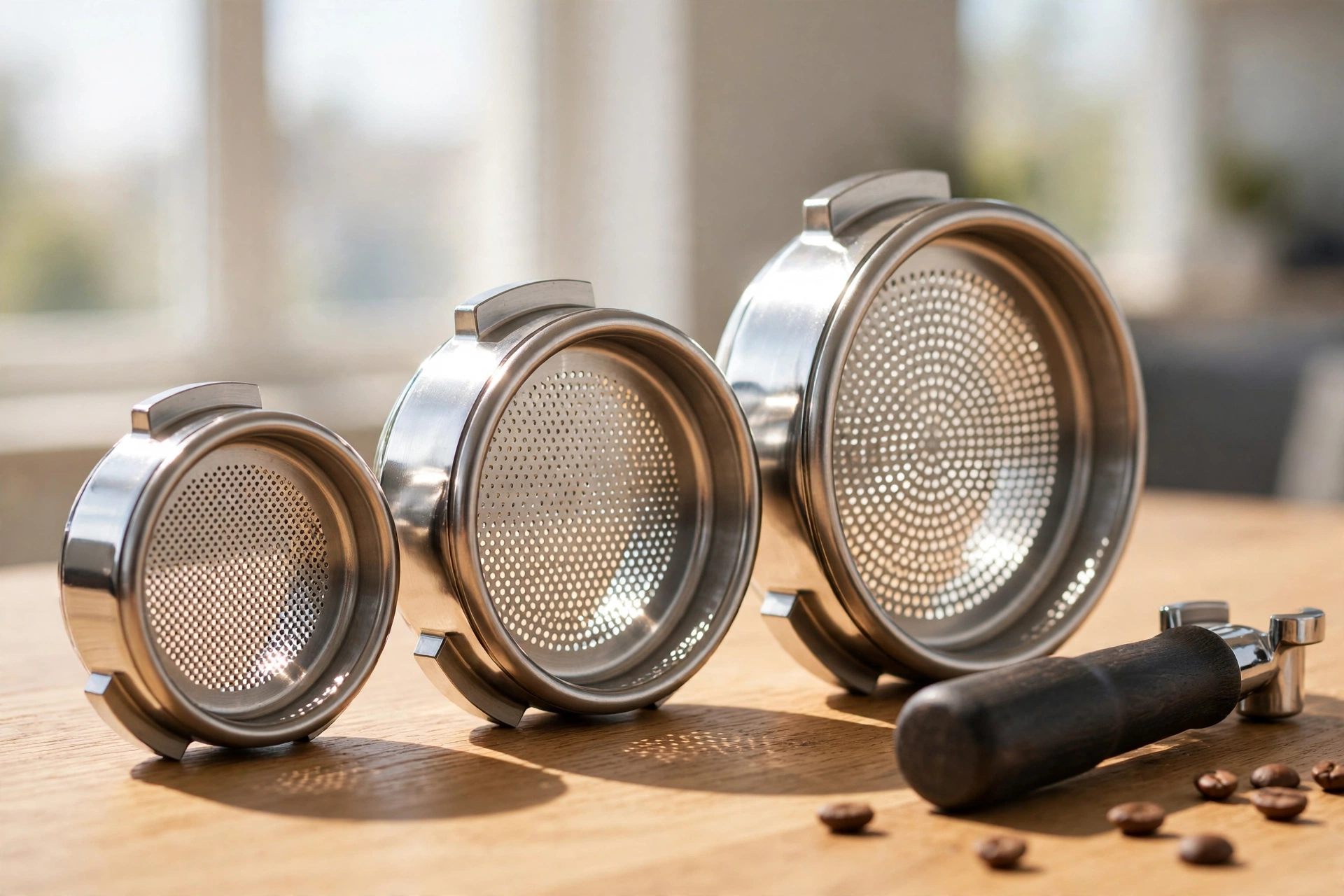
The short answer: the VST 18g Ridgeless is the best espresso filter basket for most 58mm owners — the competition-standard basket with a published ±5% open-area tolerance, for about $35. The IMS Competition B70 is the best value at about $30, the Pullman 876 is the best premium ridgeless basket at about $40, and the Pesado HE is the best high-extraction basket at about $55. Breville owners need a 54mm basket instead — the IMS 54mm at about $22 — and De’Longhi owners need the 51mm IMS Big Bang at about $23. Every pick below is a specific, current product with a checked price. Prices and specs checked 2026-11-19. Prices vary by retailer; where sources disagreed we used a current specialty retailer’s price.
Disclosure: we are an independent research desk and earn no commission on anything here. Vendor links on this page are plain links to manufacturer and retailer pages — no affiliate tracking. See our disclosure policy for how we stay independent.
We are a research desk, not a test lab: we synthesize owner reports, forum threads, published measurements, reviews, and teardowns rather than claiming hands-on testing we have not done.
First principles: what a precision basket actually changes
A stock basket is stamped. The holes are punched through sheet steel, and their diameters vary — some are partly blocked, some are oversized, and the pattern is whatever the punch press produced that day. Water follows the path of least resistance, so it flows faster through the big holes and barely at all through the blocked ones. The puck extracts unevenly: one part over-extracts and tastes bitter while another under-extracts and tastes sour, in the same cup.
A precision basket replaces the stamp with a controlled process — laser cutting or electroforming — that holds every hole to a published tolerance. VST publishes a ±5% total open-area tolerance across the whole basket; IMS publishes a 0.30mm hole diameter with a patented conical cross-section; Pullman hand-measures its baskets to a 0.30mm hole diameter with a ±0.02mm tolerance. The point of those numbers is not the numbers themselves — it is that the manufacturer is willing to state them. Most stock baskets ship with no hole specification at all.
Uniform holes change two things. First, water meets the same resistance everywhere across the puck, so extraction is more even and channeling — water finding a crack and rushing through it — becomes less likely. That is the mechanism behind the published result that precision baskets roughly halve shot-to-shot variability versus a stock basket. Second, the dose window becomes meaningful: a VST 18g is built for 17–19g, an IMS B70 18/22g for 17–20g, and dosing inside that window is part of how the basket is designed to work. Dose outside it and you are fighting the design.
Three things decide which basket is right for you, in order:
- Diameter. This is a hard constraint, not a preference. 58mm, 54mm and 51mm baskets are not interchangeable. Measure your stock basket or check your machine’s group size before ordering anything.
- Dose. Buy the basket sized for the dose you actually pull. An 18g basket is the standard double; 20g and 22g baskets suit larger doubles and triples. Underfilling a precision basket by more than about a gram leaves headspace that can fracture the puck.
- Ridged vs ridgeless. Ridged baskets lock into the portafilter spring and stay put during knock-out; ridgeless baskets swap by hand but can drop out of a spouted portafilter. The choice follows your portafilter, not your taste.
If you are still on a pressurized basket — the dual-wall basket that ships with most beginner machines — read our guide to pressurized vs non-pressurized baskets first. A precision basket is a single-wall, non-pressurized basket: it assumes fresh coffee and a grinder that can adjust finely enough to control the shot. Without those, it will not help.
Comparison table
Prices and specs checked 2026-11-19. Prices vary by retailer; where sources disagreed we used a current specialty retailer’s price.
| Basket | Fits | Dose | Hole pattern | Typical price | Best for |
|---|---|---|---|---|---|
| VST 18g Ridgeless | 58mm | 17–19g | ±5% open-area tolerance | ≈$35 | Best overall 58mm |
| IMS Competition B70 18/22g | 58mm | 17–20g | 715 holes, 0.30mm, laser-cut | ≈$30 | Best value 58mm |
| Pullman Filtration876 17–19g | 58mm | 17–19g | 876 holes, 0.30mm ±0.02mm | ≈$40 | Best premium ridgeless |
| Pesado HE 58mm Medium | 58mm | 17–19g | Up to 1,999 holes, 0.30mm | ≈$55 | Best high-extraction |
| IMS Precision 54mm (B62.52TH28E) | 54mm Breville/Sage | 18–22g | Laser-cut, 0.30mm | ≈$22 | Best for Breville |
| IMS Big Bang 51mm | 51mm De’Longhi | 15–18g | Laser-cut, dense pattern | ≈$23 | Best for De’Longhi |
The six baskets, in depth
1. VST 18g Ridgeless — best overall (58mm)
The default buy because it is the reference the rest of the category is measured against. VST pioneered precision baskets, published its manufacturing tolerance instead of just claiming “precision” on the box, and was the official filter basket of the World Barista Championship from 2013 through 2021. The 18g ridgeless suits a 17–19g dose — the standard double — and the ridgeless walls make it easy to pop out and swap by hand, which is why it is the basket most often seen in bottomless portafilters. Typical price ≈$35.
Two honest caveats. First, VST is 58mm only: it does not fit 54mm Breville or 51mm De’Longhi portafilters at all, so a large share of home-barista machines simply cannot use it. Second, it is dose-sensitive — underfill by more than about a gram and the extra headspace can fracture the puck, so it rewards owners who weigh every dose and punishes owners who eyeball it. If you dose 18g on a 58mm machine and weigh your coffee, this is the basket to buy.
2. IMS Competition B70 18/22g — best value (58mm)
IMS is the Italian manufacturer that supplies baskets to many commercial machine makers, and the Competition B70 is its flagship home-barista basket: 715 laser-cut holes at 0.30mm, a patented conical hole cross-section with a polished interior, electropolished steel, and a ridgeless body. It was built for the 2011 World Barista Championship, and it delivers near-VST consistency at about $5 less — typical price ≈$30. The 18/22g sizing takes 17–20g, a slightly wider window than the VST 18g, which makes it a touch more forgiving if your dose drifts a gram either way.
The trade-off is tolerance transparency: IMS publishes hole count and diameter but not the open-area tolerance figure VST publishes, so the consistency claim rests on the laser-cut process and owner reports rather than a single published number. In practice, owner and forum reports put it within a whisker of the VST for a few dollars less. Buy this if you want the precision upgrade and would rather keep the $5.
3. Pullman Filtration876 17–19g — best premium ridgeless (58mm)
Pullman is the Australian maker that built its reputation on the ridgeless knock-out: the basket is shaped so the spent puck drops out in one clean disc instead of sticking to the rim, which matters more than it sounds like once you are doing it twice a day. The 876 has 876 holes at 0.30mm with a ±0.02mm tolerance, hand-measured to a 58.70mm internal diameter to suit Pullman’s Big Step 58.55mm tamper base. Typical price ≈$40.
The limitation is the narrow dose window: 17–19g is the only size in this range that fits a standard double, so if you pull 20g+ doubles you need a different Pullman size (19–21g or 21–23g, same price). It is also the most expensive basket here that is not a high-extraction design. Buy it if you use a bottomless portafilter, swap baskets often, and want the cleanest puck release of the group — not if you are counting dollars per gram of improvement, where the IMS wins.
4. Pesado HE 58mm Medium — best high-extraction (58mm)
The Pesado HE is the outlier on this list: instead of a few hundred holes, it packs up to 1,999 precision-cut 0.30mm cylindrical holes into the base, which raises the flow rate through the puck and pushes extraction higher at the same recipe. The Medium size suits 17–19g; Small (15–17g), Large (19–21g) and X-Large (21–22g) cover the rest. It is made from 1.1mm stainless steel with a flat top lip for a consistent group seal. Typical price ≈$55 (A$84.90 from Australian retailers).
Two things to know before buying. First, the high hole count is a deliberate trade-off: faster flow and higher extraction suit light roasts and owners chasing clarity, but it can make dark roasts taste thin if you do not adjust the grind finer to compensate. Second, fit: Pesado sizes its 58mm baskets to its own 58.5mm standard, so check clearance in your portafilter before ordering, and note the 54mm version is also available for Breville machines (18–20g). Buy this if you roast light and want the highest-extraction basket on the list; buy the VST if you want the safe standard.
5. IMS Precision 54mm (B62.52TH28E) — best for Breville
This is the basket that changes a Breville shot most, because most Breville machines ship with a dual-wall pressurized basket that manufactures crema through back-pressure instead of extraction. The IMS 54mm is a single-wall precision basket built for Breville’s 54mm group — Barista Express, Barista Pro, Barista Touch, Bambino, Bambino Plus, Infuser and Duo-Temp Pro — with a published 18–22g dose range that is unusually wide for the diameter, because Breville baskets are comparatively deep. Typical price ≈$22, which makes it the cheapest pick on this list and the highest-leverage upgrade a Breville owner can buy. IMS lists compatibility explicitly across the 54mm Breville line, with the Oracle Jet named as the exception — check before buying for that machine.
The nanotech-coated version (about $27–30) adds a coating that stops coffee sticking to the basket, but its electropolished coating is not compatible with Cafiza and other caustic cleaning agents, so the standard version is the safer buy if you backflush with detergent — see our backflushing guide for what that means in practice. The other mainstream 54mm option is Normcore’s precision basket at about $28; the IMS is the cheaper of the two and the one with the published dose range. Either way, this is the single upgrade to make before a bottomless portafilter — see our bottomless portafilter roundup for what comes next.
6. IMS Big Bang 51mm — best for De’Longhi
The 51mm diameter has long been the neglected one — De’Longhi Dedica and La Specialista owners had almost no precision options until recently — and the IMS Big Bang is the first genuine Italian precision basket cut for it. The dense, tightly toleranced hole field is the same Big Bang pattern IMS uses on its 58mm baskets, and the published 15–18g range matches what a 51mm basket physically holds. Typical price ≈$23.
The caveat is the same as the diameter itself: 51mm is a small puck, so the basket is more sensitive to distribution errors than a 58mm basket, and a 51mm precision basket will not rescue a poor grind any more than a 58mm one will. Pair it with a grinder that can hold an espresso-fine setting and a WDT tool — see our WDT roundup — and it is the best thing to happen to the diameter in years. If you own a Dedica, this is the basket.
How to choose
- 58mm machine, standard double, weigh every dose: VST 18g Ridgeless, ≈$35. The reference standard.
- 58mm machine, same job for less: IMS Competition B70 18/22g, ≈$30, with the wider dose window.
- 58mm machine, bottomless portafilter, clean puck release: Pullman 876, ≈$40.
- 58mm machine, light roasts, chasing extraction: Pesado HE Medium, ≈$55.
- Breville or Sage 54mm machine: IMS Precision 54mm (B62.52TH28E), ≈$22. The single highest-leverage Breville upgrade.
- De’Longhi 51mm machine: IMS Big Bang 51mm, ≈$23.
Before buying any of them, check two things: that your basket diameter is actually what you think it is (58mm, 54mm or 51mm — measure the stock basket across the rim), and that your dose sits inside the basket’s published range. Get those two checks right and any basket on this list will do its job — the choice is really about which diameter you own and how much you want to pay for the last few percent of consistency.